Your weekly dose of FACTS |
|

|

Also in this week's newsletter Police debunk viral ‘leave South Africa by 30 June’ poster || Viral video of ‘armed Fulani herdsmen’ not from 2026 || No, Trump didn't warn Kenyans not to oppose a proposed Ebola facility |
Get verified news and tips straight to WhatsApp – subscribe for free! |
|

From the fact-checking desk 🔎 |
The misinformation brief |
A weekly guide to spotting, understanding and stopping viral misinformation. |
|
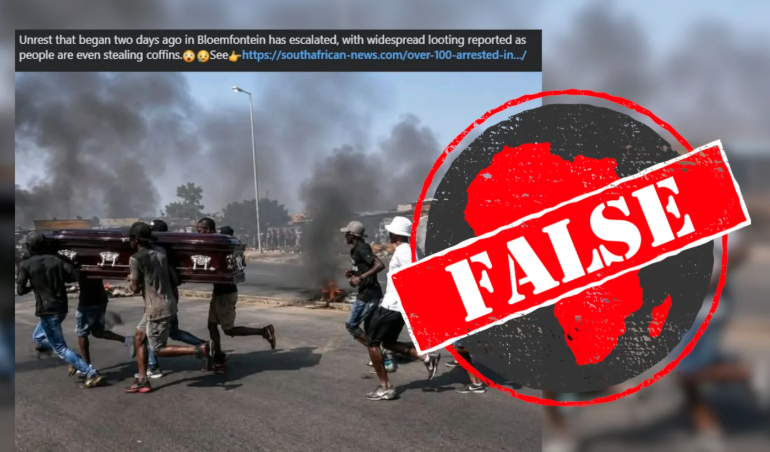
Artificial intelligence is getting better at creating realistic images. Some fakes are so convincing that even AI detection tools can struggle to identify them.
This week, we investigate a viral image that supposedly showed protesters in Bloemfontein carting away a coffin and headstone during recent looting. While the protests and looting did occur, the image itself was AI-generated. A closer look revealed several tell-tale signs.
So how can you tell when an image isn't real?
1. Ask whether the scene makes sense
Start with the basics.
Is there evidence the event actually happened? Have credible news organisations reported it? Are there other photos or videos from the same location showing the same thing?
In the Bloemfontein case, police confirmed that shops were looted, but there were no reports of coffins or headstones being stolen.
The more extraordinary the claim, the more evidence you should expect to see.
2. Check the shadows and perspective
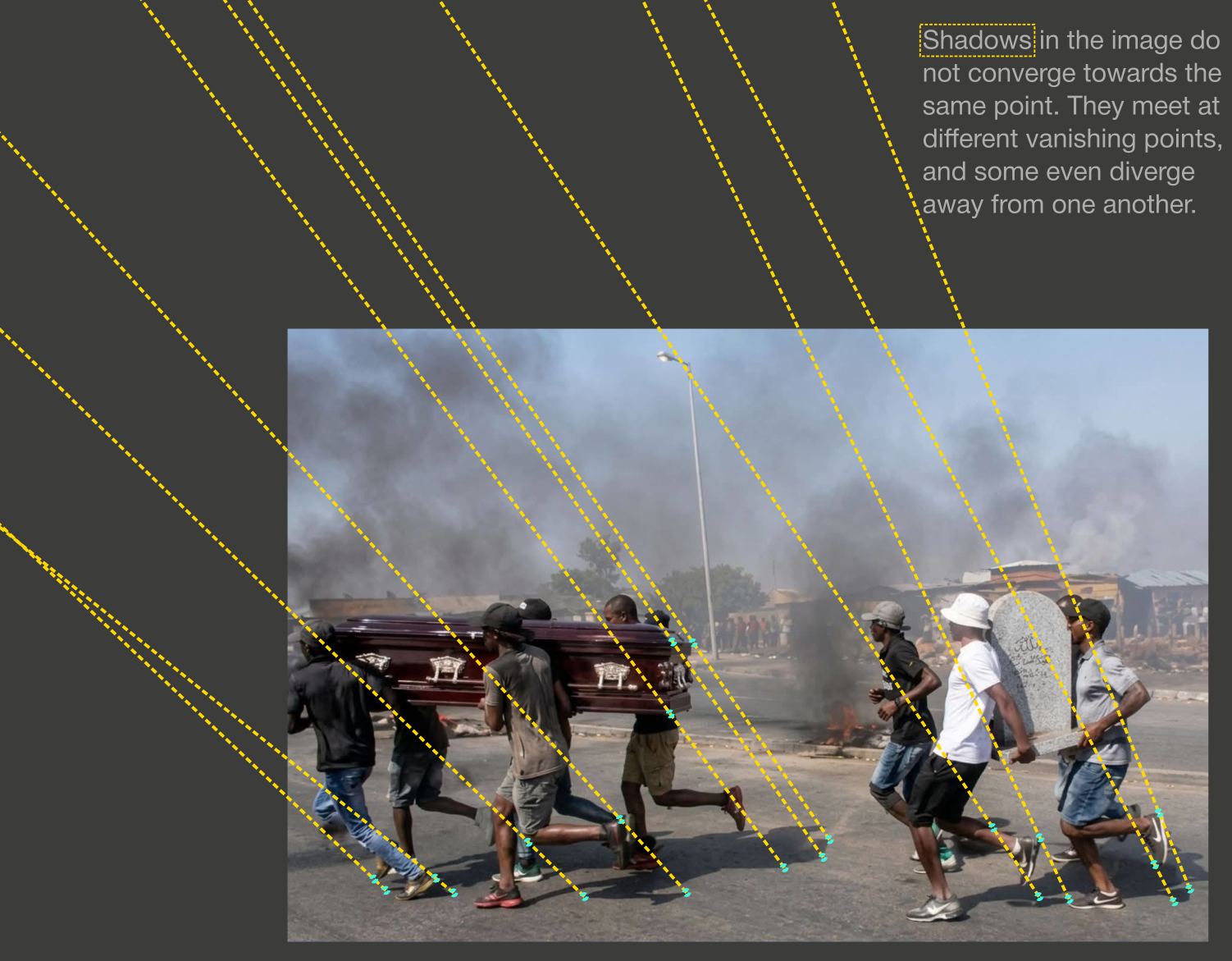
One of the most reliable ways to spot AI-generated images is to check whether they obey the laws of physics.
|
|
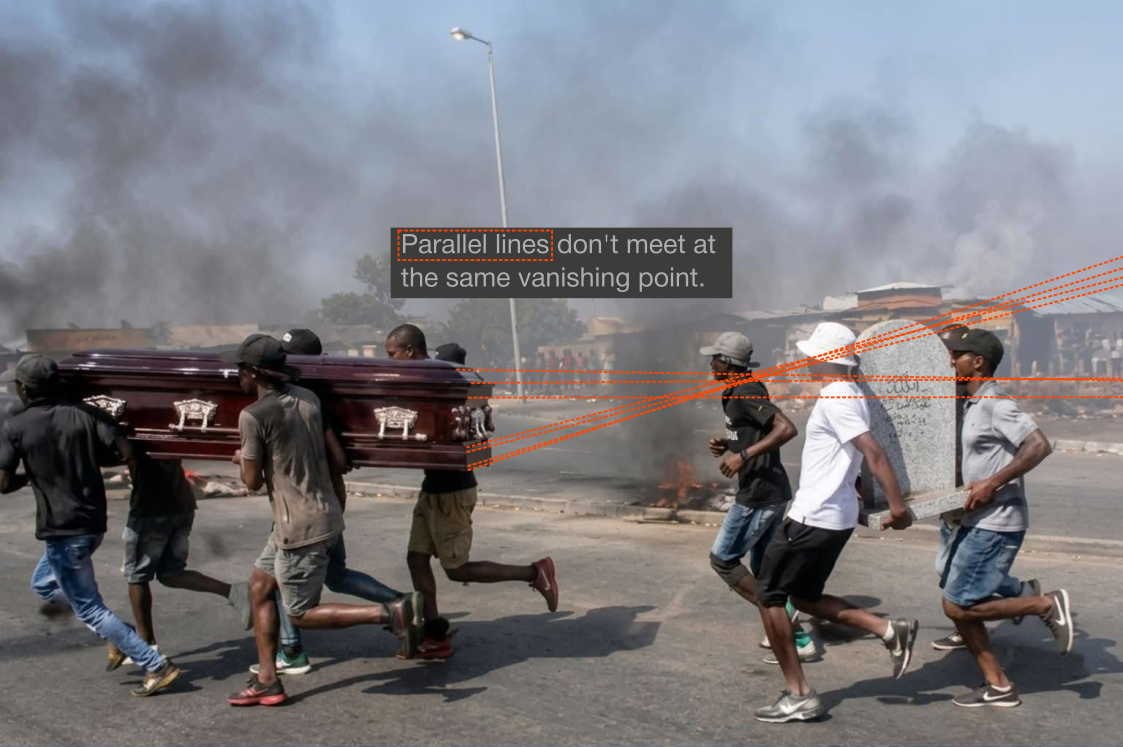
In the fake coffin image, the shadows do not line up naturally and several objects appear to obey different perspective rules, resulting in subtle visual errors that suggest the image was generated by AI. |
|
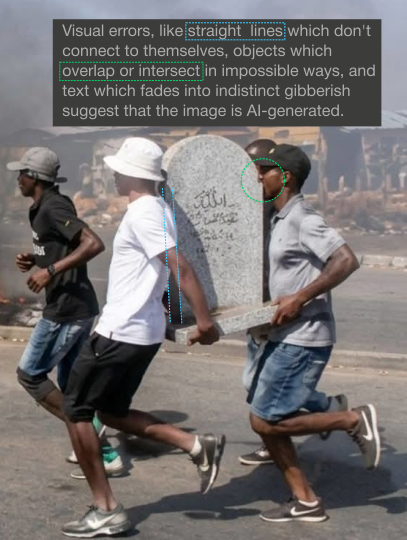
3. Zoom in on text
AI image generators still struggle with text.
In the viral coffin image, the inscription on the headstone initially appears convincing, before dissolving into meaningless characters - a common AI giveaway. |
|
4. Watch for impossible overlaps
AI can sometimes struggle to understand how objects should interact in three-dimensional space.
Look closely at where people, vehicles and other objects overlap. Do body parts merge into objects? Do items pass through each other? Are shapes joined in ways that would be impossible in real life?
In the coffin image, parts of the headstone appeared to intersect with a person's head, while other sections had shapes that could not physically exist.
5. Don't rely only on AI detectors
AI-detection tools can be useful, but they are far from perfect.
When Africa Check ran the coffin image through several AI-detection systems, the results were inconclusive. It was only through careful visual inspection and verification of the context that the image was debunked.
Before you share...
Whether an image is AI-generated or not, the most important question is: Do you know where it came from?
If an image has no clear source, no supporting evidence and raises more questions than answers, pause before sharing it.
A few extra seconds of scrutiny can stop misinformation from spreading further. |
What didn't happen 🚫 |
A roundup of some of the most popular but completely untrue stories and visuals of the week. None of these are legit, despite being widely shared. |
FAKE: A poster circulating in the name of South Africa’s department of home affairs claims “All illegal foreigners must leave South Africa by June 30th”. But the department did not issue the notice, and South African police have dismissed it as “misleading and unauthorised”.
Kenya 🇰🇪
FALSE: A graphic circulating on social media attributes a quote to self-proclaimed Kenyan prophet David Owuor, threatening Kenyans with death if they fail to vote for president William Ruto. The quote is fabricated.
FALSE: A viral graphic claims that US president Donald Trump warned Kenyans against opposing the establishment of an Ebola isolation facility in the country. This is another fabrication.
SCAM: A graphic advertising thousands of jobs at the KCB Foundation is circulating online in Kenya. The advert is fake and should be ignored.
FAKE: A graphic shared on Facebook shows the results of a June 2026 poll Politrack Africa poll ranking Nzioka Waita as the most popular candidate for Machakos governor. But the research firm says the poll is fake.
FAKE: A viral graphic quotes US secretary of state Marco Rubio as saying that president William Ruto asked to host Ebola patients in Kenya. However, the graphic is fabricated and there is no evidence Rubio made the statement.
Nigeria 🇳🇬
PARTLY FALSE: Ahead of Nigeria’s 2027 election, social media posts claim that president Bola Tinubu said many Nigerians want him dead. In context, he was referring to powerful interests affected by his economic reforms, not ordinary citizens.
MISLEADING: A widely-shared video claims Kano state governor Abba Yusuf was “distributing plates” to residents as political “empowerment packages”. But the video in fact him sharing a meal with orphans during a celebration.
MISLEADING: A viral video claims to show Fulani herdsmen arrested with weapons and explosives in Lagos in 2026. But the footage is actually from a 2022 incident and has been debunked by the Lagos state police. |
How do you like this newsletter? |
|

|

|

Love this newsletter? Please take a moment to forward it to your friends or family, or they can subscribe here. |
Thanks for reading!
Your weekly dose of facts in newsletter form is created by Laura Kapelari (@laurakapelari). It is edited by Lee Mwiti (@LMAfrican) and Cayley Clifford (@cayleyclifford). |
|


